
Pipeline
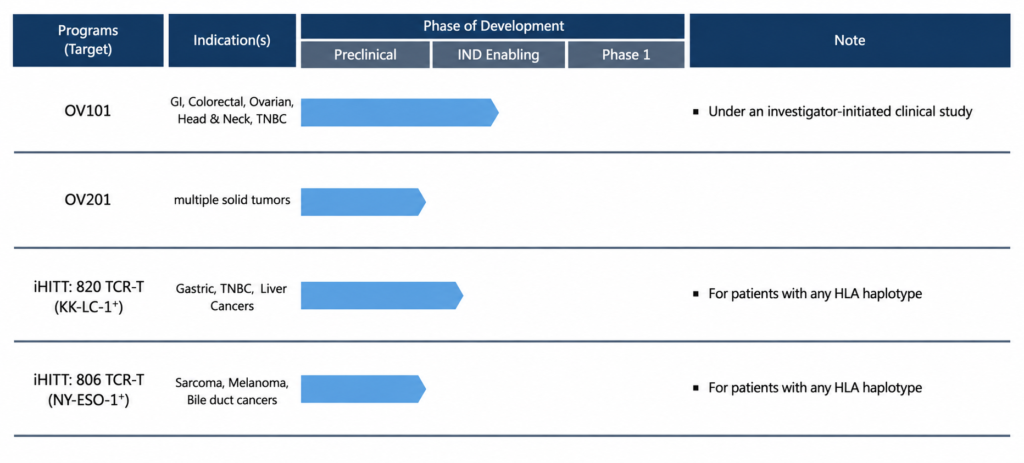
OV101 Program
T-Cure developed the OV101 oncolytic vaccinia virus under the
iACT™ platform to reprogram tumor cells into a transplanted organ,
provoking robust allogeneic T cell responses against solid tumors.
OV101 can be used as a single agent, in combination with immune
checkpoint inhibitors, TIL or TCR-T, to augment anti-tumor responses
in vivo.
OV101, as well as OV101 in combination with PD-1, is currently being
evaluated in an investigator-initiated clinical trial for patients with
metastatic cancers in the abdomen.
820TCR Program
The Kita-Kyushu Lung Cancer antigen-1 (KK-LC-1) is a cancer/testis antigen (CTA) that is expressed in
multiple solid tumors while restricted to germ line cells in normal tissues. T-Cure estimates that
KK-LC-1 is expressed in 80% gastric cancer, 75% triple negative breast cancer (TNBC), 45% non-small
cell lung cancer (NSCLC) and 40% cervical cancer. 820TCR was isolated from a complete responder
patient after Tumor Infiltrating Lymphocytes (TIL) therapy.
An investigator-initiated clinical study is currently underway in combination with OV101. This study
aims to evaluate the safety and effectiveness of targeting KK-LC-1-expressing tumors in a patient
without HLA concerns, significantly expanding the pool of eligible patients for 820 TCR-T therapies.
Preclinical studies of 820 TCR using in vivo TCR delivery is also underway with the goal to develop
the next-generation TCR-T w/o HLA constrains or ex vivo expansion.
806TCR Program
Using its iSORT platform, T-Cure identified 806TCR, an NY-ESO-1-specific TCR restricted to HLA-A2 haplotype. The 806TCR is in IND-enabling studies. NY-ESO-1 has been demonstrated clinically as a suitable target for TCR therapies for multiple solid tumors. T-Cure is currently exploring partnerships in developing “off-the-shelf” approaches to utilize this all natural but high affinity TCR in the clinic. T-Cure believes the 806TCR holds great promise as a component of such therapies.